
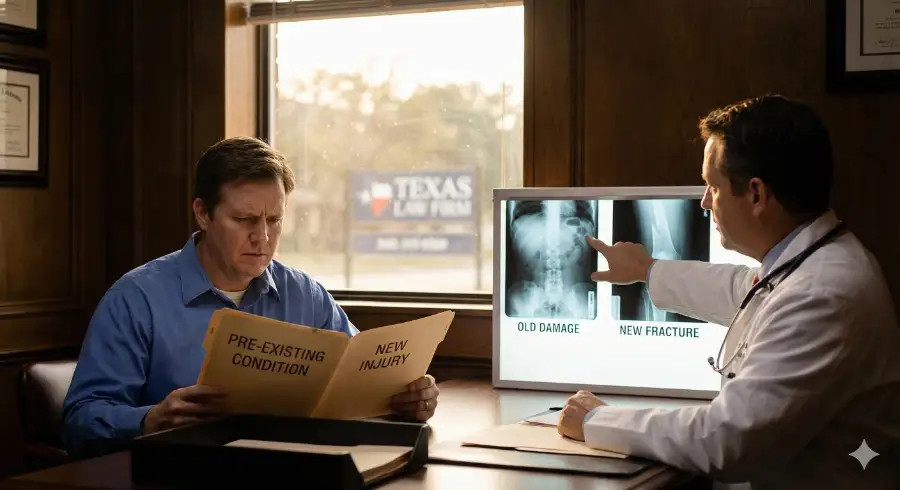
Pre-existing conditions affect millions of Texans with serious implications for personal injury claims. You get hurt in an accident, and suddenly your arthritis, diabetes, or old back injury becomes the insurance company’s excuse to deny your claim. They’ll argue your pain comes from those old health problems, not their insured driver who hit you.
But here’s what they don’t want you to know: the eggshell plaintiff rule protects you. This legal principle forces defendants to “take plaintiffs as they find them”. Your prior back injury that now needs surgery after their client rear-ended you? You deserve compensation for that aggravation. At The Law Office of Arturo Martinez, PC, we’ve spent over 30 years fighting these exact battles for injured people across Pharr, McAllen, and the Rio Grande Valley. Your pre-existing health problems won’t stop us from getting you the money you deserve.
We’ll show you exactly how pre-existing medical conditions affect your personal injury claim and what you can do to protect your rights.
What Are Pre-Existing Conditions in Injury Claims?
You need to understand exactly what pre-existing conditions mean for your case. These health issues existed before your accident, and they directly affect how insurance companies evaluate your claim and fight your compensation.
Common Types of Pre-Existing Health Conditions
Pre-existing conditions include any health problems you had before the accident happened. We see these conditions regularly in our cases:
-
Degenerative disk disease and other back problems
-
Arthritis and joint-related issues
-
Previous injuries like fractures or surgeries
-
Chronic conditions including diabetes or heart disease
-
Respiratory issues such as asthma
Mental health conditions count too – anxiety, depression, and PTSD all qualify as pre-existing conditions. Back pain ranks among the most common causes of missed work annually, making it a frequently disputed condition in personal injury claims.
How They Relate to Personal Injury Cases
Insurance companies use pre-existing conditions as their primary weapon against your claim. They’ll try to blame your current pain on your old condition instead of the accident. Their favorite argument? Your symptoms just show the natural progression of something you already had.
Here’s what matters: the difference between your “pre-accident baseline” and your “post-accident condition.” We must prove how the accident specifically changed your health. You managed mild back pain with occasional treatments before, but now you need surgery and constant medication? That’s compensable aggravation.
Don’t hide your pre-existing conditions from us. Complete honesty protects your case – failing to disclose relevant medical history can destroy your claim.
What Pre-Existing Conditions Are Not Covered
We handle cases with pre-existing conditions throughout Pharr, McAllen, and the Rio Grande Valley, but you need to understand the limits:
You cannot recover money for an injury that existed before the accident – only for how that injury got worse. You cannot claim damages for conditions unrelated to the accident or injuries that would have happened anyway.
Conditions that represent normal progression of your health issue without accident-related worsening typically aren’t covered.
Call us at (956) 781-6203 for a Free Consultation about your specific situation involving pre-existing conditions.
The Eggshell Plaintiff Rule: Legal Protection Explained
Texas law provides strong protection for people with pre-existing conditions through the eggshell plaintiff rule. This legal doctrine stops defendants from reducing their responsibility just because you were more vulnerable than the average person.
What the rule means for injury victims
The eggshell plaintiff rule (also called the “thin skull rule” or “take your victim as you find them” rule) makes negligent parties fully responsible for all injuries they cause—even when those injuries are worse because of your pre-existing condition. This legal doctrine holds defendants liable for all consequences of their actions, whether your injuries are more severe than expected or not.
The rule guarantees that people with pre-existing conditions receive fair compensation for any additional harm the accident caused. Without this protection, people with health vulnerabilities would get less money simply because they were more fragile before the incident.
How it applies in Texas personal injury law
Texas courts enforce the eggshell skull rule in personal injury cases. Texas law requires negligent parties to “take their victims as they find them”. If you have a pre-existing condition that makes you more likely to get hurt, the at-fault party stays fully responsible for all damages their negligence caused.
Insurance companies try to minimize claims by blaming pre-existing conditions, but the eggshell plaintiff rule stops that tactic from reducing your compensation. The Law Office of Arturo Martinez, PC knows how to use this rule effectively to protect clients throughout Pharr, McAllen, and the Rio Grande Valley.
Examples of aggravated injuries under this rule
Real cases show how this rule works. Someone with osteoporosis who suffers worse fractures in a car accident than most people would—the at-fault party stays liable for all resulting injuries. A person with a prior back condition who gets a herniated disk in a collision—the negligent driver cannot reduce liability because the victim’s spine was already vulnerable.
Other examples include pre-existing conditions like hemophilia (causing excessive bleeding from minor injuries), previous traumatic brain injuries, chronic back issues, and heart conditions. The Law Office of Arturo Martinez, PC has successfully represented clients with these and other pre-existing conditions.
If you believe your pre-existing condition was aggravated by an accident, call us at (956) 781-6203 for a 24/7 Free Consultation to understand your rights under this important legal protection.
Challenges You May Face with a Pre-Existing Condition
The eggshell plaintiff rule protects you on paper. But insurance companies have spent decades perfecting ways around it. They know exactly how to make your life difficult when you have pre-existing conditions.
Insurers disputing causation
Insurance adjusters will tell you straight to your face that your pain has nothing to do with the accident. They’ll claim your back was already bad, your arthritis was getting worse anyway, and the crash just happened to occur at the same time. They want to break the connection between what happened to you and why you’re hurting now.
Requests for extensive medical history
Expect them to demand your medical records going back 5, 7, sometimes 10 years. They’re fishing for anything they can use against you. That one time you mentioned back soreness to your doctor three years ago? They’ll blow it up like you’ve been disabled your whole life. Every doctor visit becomes ammunition for their argument.
Misuse of the eggshell rule by insurance companies
Here’s their favorite trick: they’ll agree the eggshell rule exists, then argue you were going to get worse no matter what. They’ll hire their own doctors to say your condition was “destined to deteriorate” and the accident just sped up the inevitable. It’s their way of turning your legal protection into their escape route.
Acute onset of pre-existing conditions: what it means
This happens when a condition you never even knew you had suddenly becomes a major problem after trauma. You might have lived fine with a weak spot in your spine until someone slammed into you. Now that weak spot needs surgery and constant treatment.
We’ve seen every one of these tactics at The Law Office of Arturo Martinez, PC. Call us at (956) 781-6203 for a 24/7 Free Consultation.
How to Strengthen Your Claim Despite a Pre-Existing Condition
You have a pre-existing condition and got hurt in an accident. Insurance companies will try every trick to pay you less. Here’s how we fight back.
Be transparent with your attorney
Tell your personal injury lawyer everything about your medical history. We can’t protect you from problems we don’t know about. Hiding information will destroy your case. Attorney-client privilege keeps your conversations confidential, so share every detail about your health conditions.
Gather pre- and post-accident medical records
Medical documentation shows exactly how the accident changed your health. We need comprehensive records from before and after your accident – doctor’s notes, test results, imaging studies, treatment plans. These records prove what your health looked like before someone else’s negligence hurt you.
Use expert medical testimony
Medical experts explain the difference between your old condition and new injuries to insurance companies and juries. These professionals establish causation by showing how the accident specifically made your condition worse. Their testimony carries serious weight in settlement negotiations and courtrooms.
Track symptoms and changes in health
Keep a detailed journal of your daily pain levels, physical limitations, and how your condition affects your life. This personal record proves how your life changed after the accident.
Quantify damages from aggravated harm
We separate what you can’t recover (your original condition) from what you deserve compensation for (how the accident made it worse). The Law Office of Arturo Martinez, PC documents and quantifies these damages properly. Call (956) 781-6203 for a 24/7 Free Consultation.
Conclusion
Insurance companies want you to think pre-existing conditions end your case. They’re wrong. The law protects you, and we know how to use it.
You don’t need to hide from your medical history. Tell us everything. We’ll build your case around the truth, not around what the insurance company wants to hear. We’ve done this for over 30 years in Pharr, McAllen, and across the Rio Grande Valley.
Your old back injury doesn’t make you worth less money. Your diabetes doesn’t reduce what you deserve. When someone else’s negligence makes your condition worse, they pay for that damage. Period.
The Law Office of Arturo Martinez, PC fights insurance companies who try to cheat people with pre-existing conditions. We use expert witnesses, medical records, and decades of courtroom experience to get you the settlement you deserve. Each case is different, but our commitment stays the same.
Your health history is part of your story, not the end of it. Call us at (956) 781-6203 for a 24/7 Free Consultation and let us show you how we can turn your pre-existing condition into proof of why you deserve more money, not less.
Key Takeaways
Understanding how pre-existing conditions affect personal injury claims can mean the difference between fair compensation and being denied what you deserve.
• The eggshell plaintiff rule protects you – Defendants must “take plaintiffs as they find them,” meaning you’re entitled to full compensation even if pre-existing conditions made your injuries worse.
• Transparency with your attorney is crucial – Hiding medical history can severely damage your case, while complete honesty allows your lawyer to build the strongest possible defense.
• Document everything before and after the accident – Comprehensive medical records create a clear “before-and-after” picture that proves how the accident specifically worsened your condition.
• Insurance companies will challenge causation – Expect insurers to argue your injuries stem from pre-existing conditions rather than the accident, but proper evidence and expert testimony can counter these tactics.
• Track daily symptoms and limitations – Maintaining a detailed journal of pain levels and how your condition affects daily activities provides compelling evidence of accident-related aggravation.
Having a pre-existing condition doesn’t disqualify you from receiving compensation—it simply requires a more strategic approach to prove how the accident specifically worsened your health beyond its natural progression.
FAQs
Q1. How does the eggshell plaintiff rule protect people with pre-existing conditions in injury claims? The eggshell plaintiff rule ensures that defendants are fully responsible for all injuries they cause, even if the victim’s pre-existing condition makes the injuries more severe. This rule protects vulnerable plaintiffs and prevents discrimination in the legal system.
Q2. What challenges might I face when filing an injury claim with a pre-existing condition? You may encounter insurance companies disputing causation, requesting extensive medical history, and attempting to attribute your current symptoms to your pre-existing condition rather than the accident. They might also misuse the eggshell rule to minimize compensation.
Q3. Should I disclose my pre-existing condition to my personal injury attorney? Yes, it’s crucial to be completely transparent with your attorney about your medical history. This allows them to prepare the strongest possible case and protect you from potential issues that could arise if this information is discovered later.
Q4. How can I strengthen my injury claim despite having a pre-existing condition? You can strengthen your claim by gathering comprehensive pre- and post-accident medical records, using expert medical testimony, tracking your symptoms and health changes daily, and clearly quantifying damages from aggravated harm caused by the accident.
Q5. Can I still receive compensation if my pre-existing condition was aggravated by an accident? Yes, you can still receive compensation if an accident aggravates your pre-existing condition. The law protects your right to compensation for any worsening of your condition due to another’s negligence, regardless of your prior health status.